Homeowners and small-property managers often ask the same practical question: if several smoke alarms can sound together across rooms, is that enough? Or do you still need a dedicated fire alarm system?
The short answer is: YES—interlinked smoke alarms can replace a fire alarm system as long as your local authority permits standalone smoke alarms and does not mandate a building fire alarm system for your type of property. Checking your local code first is the one step that decides everything: if standalone units are allowed, interlinked alarms give you full multi-room coverage without the cost and complexity of a dedicated system; if a fire alarm system is required, no amount of interlinking will satisfy the code.
This confusion shows up in real homeowner discussions, including threads such as “Fire alarm system for a house” on Reddit’s r/firealarms community: people compare full household fire-alarm systems with interconnected residential smoke alarms and try to work out what a house actually needs.
Smoke alarm, smoke detector, and fire alarm system are not the same thing
Everyday shopping language mixes these terms. Fire-protection practice separates them by role.
Smoke alarm senses and sounds
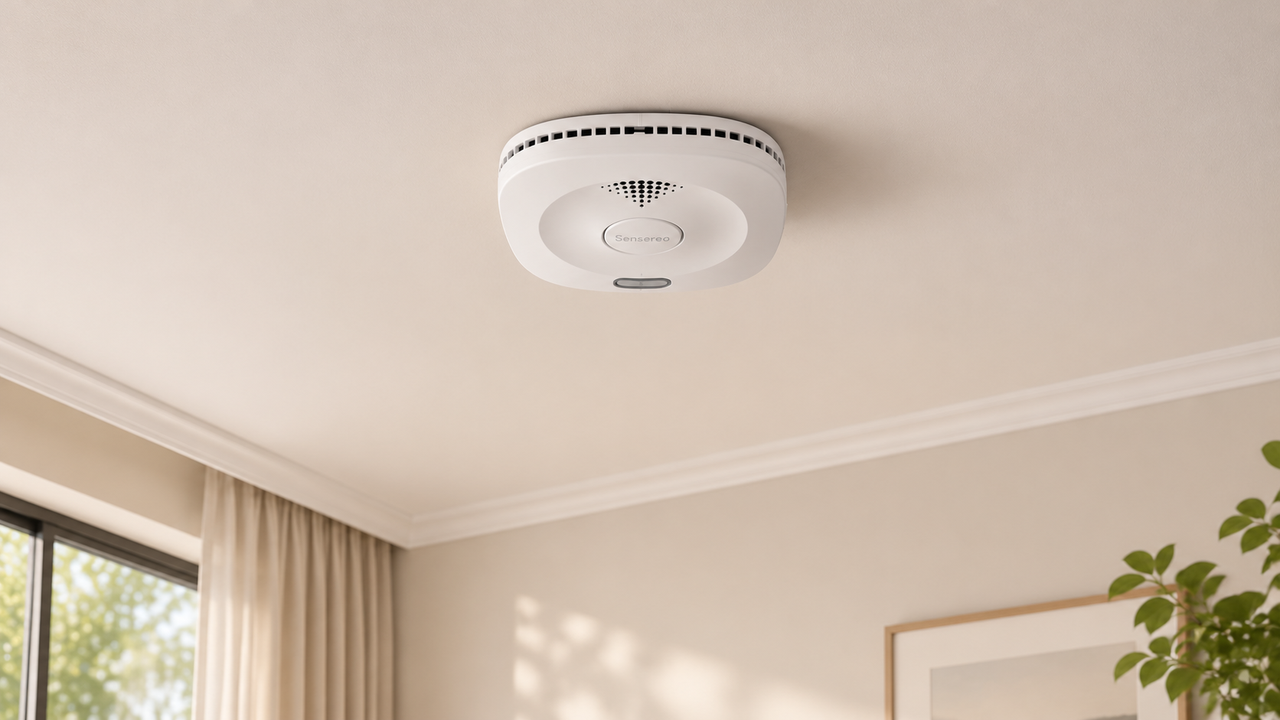
A smoke alarm is a residential, typically self-contained device that senses smoke and sounds a warning so people can evacuate. The familiar ceiling or wall unit with a test button is almost always a smoke alarm. Multiple-station (interlinked / interconnected) smoke alarms still sit in this category: when one sounds, compatible linked alarms sound too.
Smoke detector only senses
A smoke detector is primarily a sensor. It reports smoke conditions to a fire alarm control unit. The panel—not the detector alone—controls how notification appliances sound and whether a signal goes further. Detectors are common in commercial buildings and many multi-unit systems.
Fire alarm system may contain smoke detector
A fire alarm system (FAS) is a designed building system: initiation devices (often detectors), a control unit, notification appliances, power supplies, and—depending on the design—monitoring, zone indication, and building-level response. It is not simply “several loud alarms in rooms.”
|
|
Smoke alarm
|
Smoke detector
|
Fire alarm system
|
|---|---|---|---|
|
Core job
|
Sense smoke and warn occupants
|
Sense smoke and signal a control unit
|
Detect, process, notify, and manage fire alarm functions at building/system level
|
|
Sounder
|
Built into the unit (or linked residential alarms)
|
Usually separate appliances controlled by a panel
|
Designed notification circuits / appliances
|
|
Typical setting
|
Homes and many residential dwellings
|
Commercial / multi-unit system installs
|
Buildings where code or risk assessment requires a system
|
|
Management
|
Occupant testing and manufacturer instructions
|
Part of system inspection & maintenance
|
Programmed control unit, zones, testing regime
|
Retail packaging may still say “detector” for a home unit that sounds on its own. For buying decisions, ask: Does it sound locally? Does it need a building panel? Can it interconnect with other residential alarms?
What interlinked smoke alarms actually do—and do not do
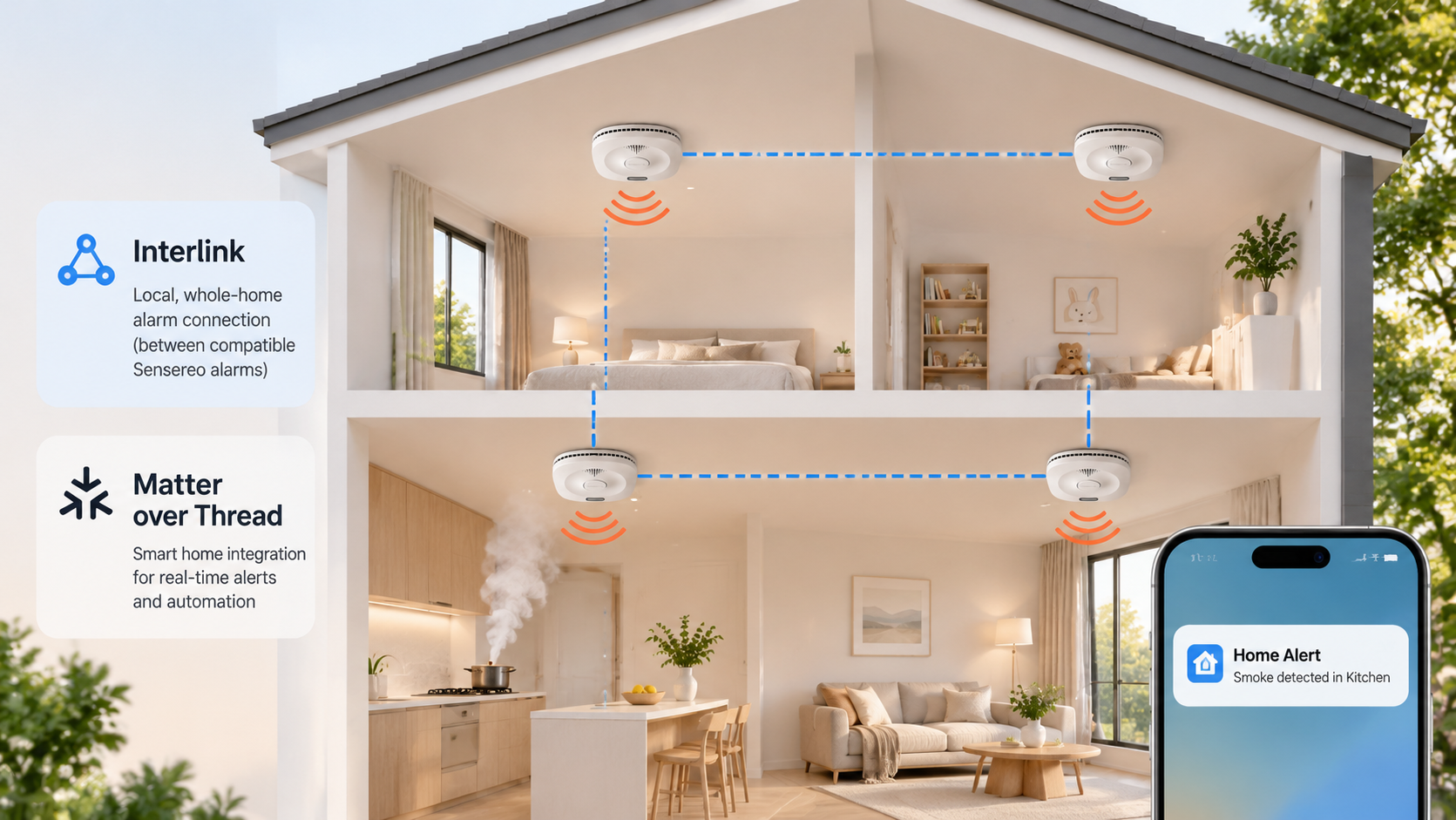
Interlinked (interconnected) smoke alarms improve audible coverage: when one compatible alarm detects smoke and sounds, other compatible alarms on the same interlink arrangement can sound as well. That matters in large homes, multi-story dwellings, and layouts where a single sounding unit might not be heard clearly in every sleeping area.
What they typically do:
-
Provide earlier whole-home audible warning than isolated stand-alone units.
-
Support wired interconnection or listed wireless / local-radio methods, depending on the product.
-
Remain residential smoke-alarm devices—not panel-based system detectors.
What they do not automatically provide:
-
A fire alarm control unit with building-level zones, programmed notification, or central station monitoring.
-
Cross-building networking or estate-wide supervision.
-
A legal substitute wherever local codes require a dedicated fire alarm system for the occupancy.
In short: better multi-room warning ≠ complete fire alarm system.

When interlinked smoke alarms can be a practical solution
Upgrade reality often looks like this: rewiring is expensive or disruptive; the whole building cannot be brought onto one system at once; or the goal is better protection inside a dwelling unit than a single stand-alone alarm can offer—without commissioning a full FAS.
Large homes and multi-story dwellings
In a large house, a kitchen or basement fire may not wake someone in a distant bedroom if only one alarm sounds nearby. Interlinked alarms address that hearing problem. Many residential codes and life-safety practices encourage interconnected smoke alarms in dwellings for that reason. That is still a residential smoke-alarm strategy, not a commercial panel system.
Small businesses and small commercial premises
Some small shops, studios, or office units sit in buildings where a full system retrofit is disproportionate to the unit’s size—or where the landlord controls the building system and the tenant can only improve in-unit warning. Wireless interlinked residential-style alarms may reduce renovation difficulty for local audible coverage. They do not replace whatever fire-alarm provisions the occupancy and authority having jurisdiction require for the premises as a whole.
Public housing and existing residential stock
Public housing and older multi-unit stock are a clear case where whole-building FAS retrofit is often impractical unit by unit. Residents and housing agencies may still need earlier warning inside the flat.
Public programs in Asia illustrate the unit-level approach:
-
Hong Kong Fire Services Department (FSD) promotes wider voluntary use of battery-operated stand-alone fire detectors (獨立火警偵測器) in domestic premises to give earlier warning and more time to evacuate. From 1 September 2021, voluntarily self-installed stand-alone units of this kind are treated differently from statutory / required installations: they are exempted from certain duties under the Fire Service (Installation and Equipment) Regulations that would otherwise require a Registered Fire Service Installation Contractor for installation and maintenance of regulated equipment. Stand-alone here means a self-contained sensor, alarm, battery, and test button—not part of the building fire-detection system circuitry. Required detectors that form part of a regulated installation remain under the normal regulatory regime. (See FSD / GovHK materials on stand-alone fire detectors: GovHK press release; FSD stand-alone fire detectors.)
-
Singapore Civil Defence Force (SCDF) promotes the Home Fire Alarm Device (HFAD)—an automatic smoke or heat detector that sounds to alert occupants (smoke preferred for homes). HFAD became mandatory for new residential premises and for existing premises doing fire safety addition and alteration (A&A) with plans submitted on or after 1 June 2018, and is strongly encouraged for older homes. Support schemes such as HFAD assistance for HDB public rental flats and EASE subsidies for seniors reflect the same idea: improve home-level early warning even when every block cannot be rebuilt around a new panel. (See SCDF HFAD and Ministry of Home Affairs public replies on HFAD uptake.)
In these settings, stand-alone or interlinked residential alarms can be a practical way to raise protection inside units where a uniform whole-building system upgrade is not on the table. That is deployment convenience with a real safety purpose—not a claim that residential interlink equals building FAS.
When a dedicated fire alarm system is necessary
Choose—or keep—a dedicated fire alarm system when:
-
Local fire codes or the authority having jurisdiction require one for the occupancy, building height, use, or alteration scope.
-
You need building-level detection, notification, zoning, or monitoring—not only room-to-room residential sounding.
-
The property is a commercial, assembly, healthcare, or multi-unit design where detectors report to a control unit and notification is engineered as a system.
-
Risk assessment, insurer, or fire-engineering advice specifies a system rather than residential smoke alarms alone.
Interlinked smoke alarms can coexist with building systems in some properties (for example, in-unit alarms plus corridor detectors), but they do not absorb the system’s legal or design role. If the code path for your building is a fire alarm system, residential interlink is not a DIY replacement.
An example of wireless residential interlink: Sensoreo MS-1 Interlink
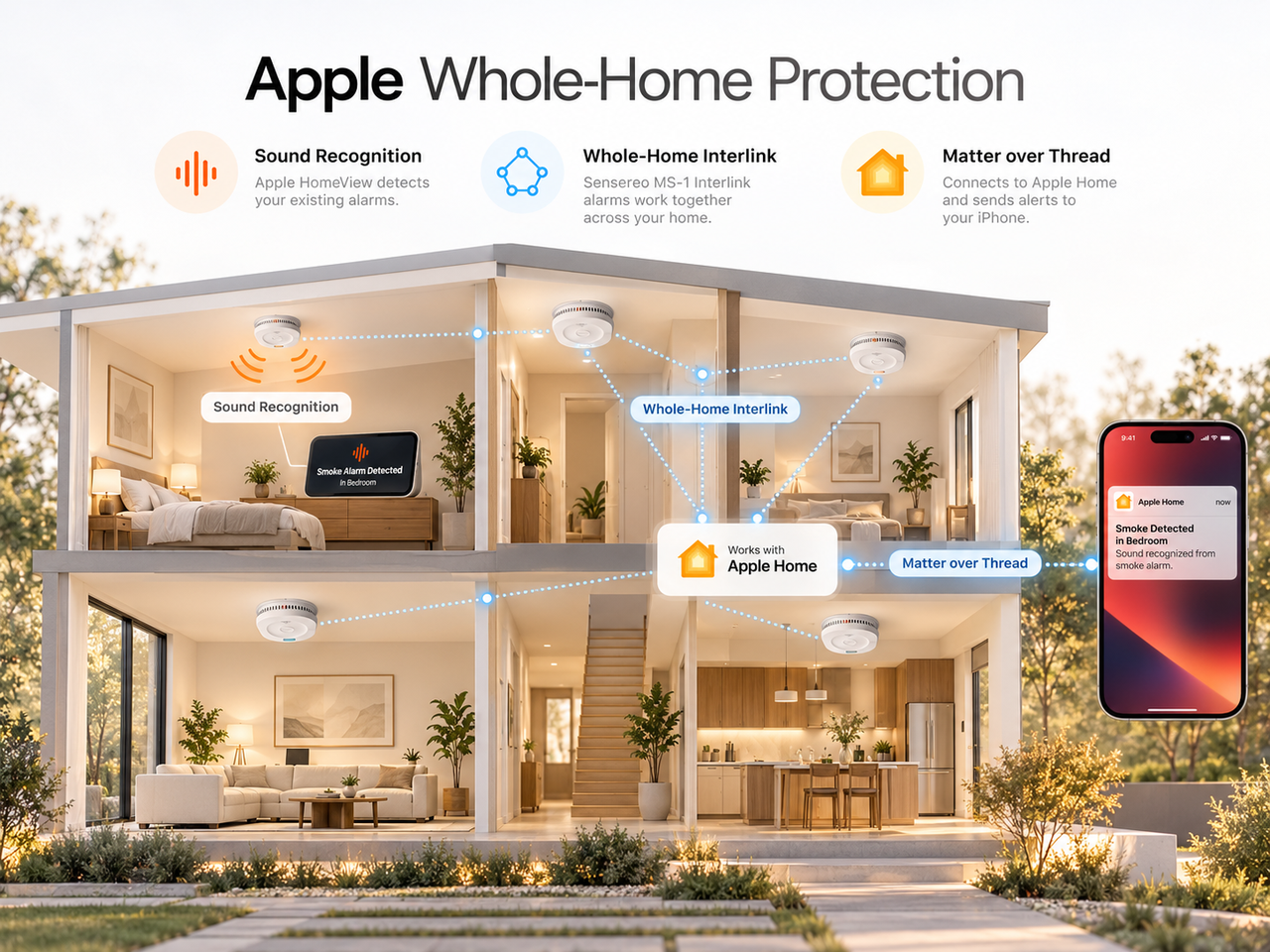
Product choice is secondary to the boundary above. For readers comparing residential options, Sensereo MS-1 Interlink Version is one example of a Matter over Thread residential smoke alarm that also offers Thread-based Interlink: when one compatible Interlink alarm detects smoke and sounds, other compatible Interlink alarms on the local Thread network can sound too.
A few facts that matter for this article’s topic:
-
Interlink is alarm-to-alarm communication on a local Thread network—not building central monitoring and not cross-building networking.
-
Interlink can continue during a Wi-Fi or internet outage as long as the local Thread network remains active.
-
Standard MS-1 does not include this Interlink function, cannot gain it by firmware update, and cannot join the same Interlink network as Interlink Version units.
-
MS-1 Interlink Version is priced at US$59.99 (standard MS-1 at US$49.99).
Use that only as a concrete illustration of wireless residential interlink—not as proof that any interlinked product can replace a required FAS.
Quick FAQ
Can interlinked smoke alarms replace a fire alarm system?
Not when a dedicated fire alarm system is required by code, occupancy, or building design. Interlinked alarms can improve residential audible coverage; they do not automatically provide central management, building-level monitoring, or engineered system notification.
Are wireless interlinked alarms the same as central monitoring?
No. Local wireless or Thread-based interlink makes compatible alarms sound together in a home or unit. Central monitoring and cross-building networking are different system functions.
Why do Hong Kong and Singapore promote home stand-alone devices?
Because many domestic premises benefit from early warning inside the home, and voluntary or unit-level devices can be deployed without waiting for a whole-building system redesign. Statutory or required system equipment remains separately regulated.
Is one solution right for every building?
No. Building use, local fire requirements, and risk assessment decide whether stand-alone alarms, interlinked residential alarms, a household fire-alarm control arrangement, or a full building FAS is appropriate.
Closing
Interlinked smoke alarms answer a real problem: people need to hear a warning in more than one room, and many existing homes, small premises, and public-housing units cannot easily take a full fire-alarm-system retrofit. Used in that role, they are a practical fire-safety tool.
They are not a universal upgrade path, and they are not a replacement for a code-required fire alarm system. Start from occupancy and local requirements; then choose the technology that matches the job—unit-level audible coverage, or building-level detection and control.
If you are evaluating residential smoke alarms with optional whole-home audible interlink for a dwelling or small premises (and your local rules allow that approach), review product manuals, placement guidance, and whether the interlink method matches your layout—then decide with the code boundary still in view.